










A Fortebet prediction is an estimate, not an announcement. It takes what two teams have already done - goals scored, shots conceded, points collected away from home - and turns that history into a probability for the next ninety minutes. Nothing about that process removes risk, and any page that promises otherwise is selling something. What analysis does is narrow the gap between a guess and an informed opinion.

This page explains how a Fortebet prediction is built, which numbers actually matter, and how to read them without fooling yourself. It is written for people in the Republic of the Congo who follow European leagues and African competitions alike, from complete beginners to bettors who already track their own stats in a notebook or a spreadsheet.
How Fortebet Predictions Work
The word prediction covers several different things. Sometimes it means a single suggested outcome, such as a home win or over 2.5 goals. Sometimes it means a probability distribution: 46% home, 27% draw, 27% away. The second version is more honest and more useful, because it tells you how confident the analysis really is. A 46% favourite loses often. That is not a broken model - that is football.
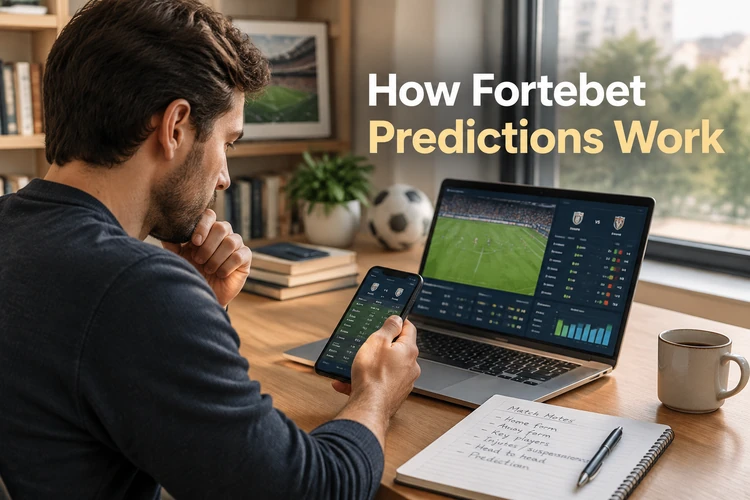
The inputs are public and fairly ordinary. Recent results over five to ten matches, goals for and against, shots and shots on target, possession in a rough sense, corners, cards, and the composition of the starting eleven. Add context that never appears in a results table: a Tuesday cup game before a Saturday derby, a squad travelling three thousand kilometres, a manager appointed ten days ago. Different indicators are used together because each one covers the blind spot of another. Scoreline data tells you what happened; shot data tells you whether it was likely to happen again.
Fortebet Predictions for Today
Daily previews follow the fixture list rather than a fixed schedule, so a busy midweek round produces far more material than a quiet Monday. When you look at today's matches, start with form, but read it properly. Five wins against bottom-half opposition is not the same as two draws against the top three. Look at who the goals came against and whether the team created chances or converted an unusual number of half-chances.
Motivation deserves as much attention as ability. A mid-table side in April with nothing to play for behaves differently from one fighting relegation by a single point. Teams already qualified rotate. Teams needing a draw defend deep and the goal line drops. If you check the fixtures from the Fortebet homepage before kick-off, you will often see the market has already moved for exactly these reasons, which is a signal worth reading rather than ignoring.
Fortebet Mathematical Prediction
Mathematical models replace opinion with counting. The most common approach treats goals as a Poisson process: estimate how many goals each side should score against this specific opponent, then calculate the chance of every scoreline and add them up into match odds, over/under lines and both-teams-to-score probabilities.

Expected goals, usually written xG, feeds those estimates. Each shot gets a value based on distance, angle and situation - a tap-in might be 0.7, a speculative effort from thirty metres 0.02. A team that lost 0-1 with 2.4 xG against 0.4 played well and got nothing, and over the next month it will probably score more. Home advantage still exists and is normally worth a fraction of a goal. Ratings systems such as Elo strip results down to a single number that rises and falls with each result weighted by opponent strength.
- Attack strength: goals scored compared with the league average, split by home and away.
- Defence strength: goals and chances conceded, with the same home and away split.
- Expected goals difference: the gap between xG created and xG allowed over the last ten games.
- Schedule load: minutes played and days of rest for the likely starting eleven.
Fortebet Betting Tips
Market choice matters more than most beginners expect. Over/under and double chance behave more predictably than exact scorelines, because they aggregate many possible outcomes. Correct score markets carry long odds precisely because they are hard to hit. Pick the market that matches the strength of your read: if your edge is on goals, bet goals, not the winner.
Compare the odds with your own probability estimate. If you think a side wins 50% of the time, anything above 2.00 is value and anything below is not, regardless of how much you like the team. That comparison is the whole discipline. A value bet only exists if your estimate is honest. Stake a fixed small share of your bankroll - one or two percent is standard - and judge results over a hundred bets rather than one weekend. Chasing losses with bigger stakes is the fastest way to end a bankroll.
Football Prediction Analysis
Head-to-head records are interesting but overrated; squads change, managers change, and a 2019 result explains little. Injuries and suspensions matter far more, especially when they hit a first-choice goalkeeper, a central defensive pair, or the one creative midfielder a team builds through. Style clashes are real too: a side that presses high can be dismantled by direct long passing.

Fixture congestion shows up in the last twenty minutes, when tired legs concede late goals. Weather changes games in the rainy season. Referee tendencies shift card and penalty markets. None of this is exotic knowledge - it just requires reading the team news instead of the badge, and it is easier to track once you are signed in and following your own selections from your Fortebet account.
Responsible Gambling
Betting always carries risk, and no analysis removes it. There is no such thing as a certainty in football, and predictions on this page are analytical information rather than advice or a promise of profit. Losing runs happen to good models and good bettors.
Use only money you can afford to lose, set deposit and time limits before you start, and never bet to recover previous losses. If betting stops being entertainment, take a break and use the self-exclusion and support options described on our responsible gambling page. Betting is for adults aged 18+ only.
FAQ
It is an analytical estimate of how a football match is likely to unfold, based on team statistics, recent form, squad news and probability calculations. It suggests which outcomes look stronger, but it is not a guarantee and should be treated as one input into your own decision.
A model estimates how many goals each team should score against a specific opponent, using attack and defence strength, expected goals and home advantage. Those estimates are converted into probabilities for every scoreline, then grouped into result, over/under and both-teams-to-score markets. The output is a percentage, not a certainty.
Analysis follows the fixture calendar, so busy match days produce more previews than quiet ones. Numbers are also revised close to kick-off when team news, injuries or lineup leaks appear. Checking again shortly before the match is usually worthwhile.
Expected goals for and against over the last eight to ten matches, home and away splits, and the availability of key players carry the most weight. Possession and corner counts matter less than they first appear to. Head-to-head history is usually the most overrated statistic in football analysis.
It means deciding in advance how much money is set aside for betting and staking a small fixed share of it, typically one or two percent, on each selection. This keeps a losing run from wiping out the whole balance and reduces emotional decisions like doubling stakes after a loss.
No. Football contains too much randomness for any method to remove risk, and even strong analysis loses regularly. Anyone claiming certain outcomes is not describing how probability works.